Claude API vs OpenAI API for Business Automation: September 2026 Verdict
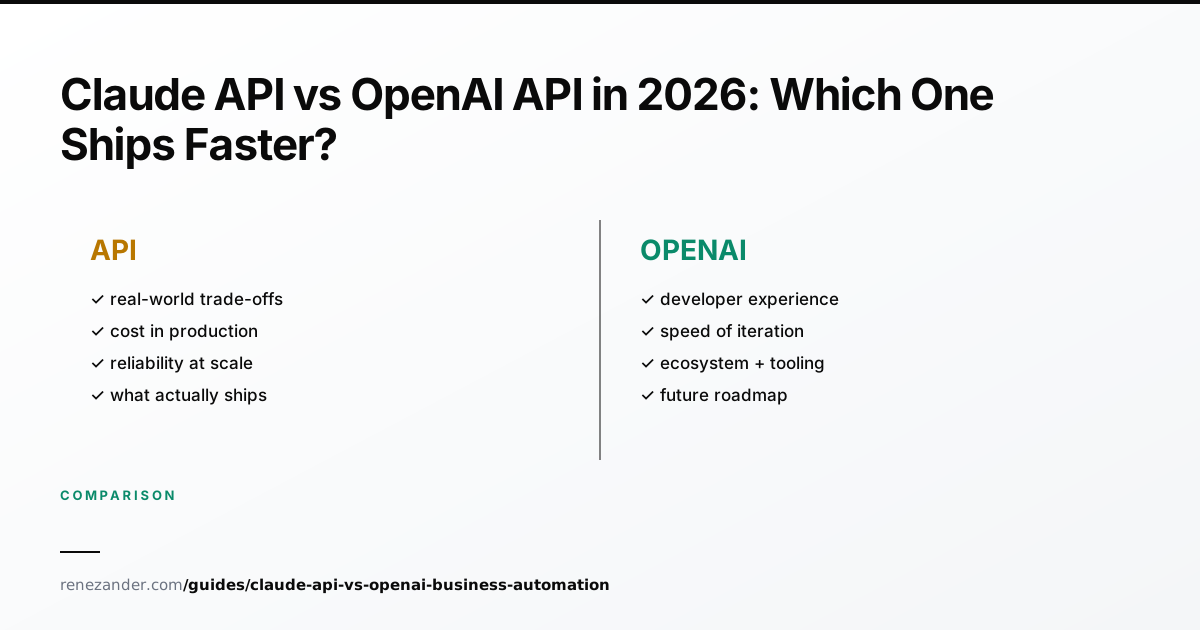
The decision, as of September 2026: if your automation processes EU personal data and legal wants an in-region path on the vendor’s own API, OpenAI is the only one of the two that offers it; Claude’s EU processing goes through Google Cloud or Amazon Bedrock regional endpoints. If you already buy through Azure or AWS, both are available there; Google Cloud carries Claude only. On price and caching the two have converged, so output behaviour on your own documents and exit cost decide.
Claude API vs OpenAI API for business automation, September 2026: list prices are close (Claude Sonnet 5 at $3 in and $15 out per million tokens, GPT-5.6 Terra at $2 and $12), both discount cache reads by 90 percent, both support parallel and schema-strict tool calls. EU data residency, cloud procurement path and exit cost decide, not model quality.
I integrate LLM APIs into business automation systems. Content pipelines, document processing, customer communication flows, data enrichment. Not chatbots. Production systems that run unattended and need to work every time.
From that angle, here is how Claude and OpenAI actually compare.
Standardizing on one for your team
If you are choosing a default LLM provider for a team rather than wiring a single integration, the deciding factors move from raw quality to cost exposure at volume, vendor lock-in, and EU data residency. On price and caching the two have converged; the deciding factors are where inference runs, which marketplace bills you, and what a later switch would cost. For EU-based teams the residency question has a concrete answer in September 2026. OpenAI processes and stores in Europe on its own API (eu.api.openai.com) for customers approved for Modified Abuse Monitoring or Zero Data Retention, at a 10 percent uplift, and offers an EU data zone through Azure. Anthropic’s own API offers only global or US-only inference and US-only workspace storage; Claude runs in the EU through Google Cloud’s EU multi-region endpoint or Amazon Bedrock regional endpoints, at a 10 percent premium over global endpoints, with model coverage varying by region. Since 2 August 2026 the AI Act’s Article 50 transparency duties apply to deployers regardless of provider; high-risk Annex III obligations were deferred to 2 December 2027 by Regulation (EU) 2026/1744. The generative AI for business in DACH guide covers the procurement side. Pick one as the default, keep the other behind the same interface as a fallback.
The Short Version
OpenAI has the ecosystem. Claude has the output quality. Both work. Your choice depends on what you are building and what failure mode you can tolerate.
Claude vs OpenAI: Response Quality for Business Tasks
This is where the comparison gets interesting, because “quality” means different things for different tasks.
Structured Data Extraction
Both APIs can extract structured data from unstructured text. Invoice parsing, email classification, resume screening. For these tasks, I consistently see Claude produce cleaner structured output with fewer hallucinated fields.
OpenAI’s function calling and structured output mode (JSON mode) work well, but Claude’s tendency to follow instructions precisely rather than creatively makes it better suited for extraction tasks where you want the model to report what is there, not infer what might be. I cover the prompt scaffolding and schema tricks that make this reliable in Claude structured output patterns.
Content Generation
For generating business content (emails, reports, summaries, social media posts), Claude produces text that reads more naturally and requires less post-processing. The writing is less formulaic.
OpenAI is serviceable here but tends toward a recognizable style that clients notice. “This sounds AI-generated” is feedback you do not want.
Reasoning and Decision-Making
When the automation needs the LLM to make a judgment call (classify this support ticket, decide which template to use, determine if this lead is qualified), both perform well. Claude tends to be more conservative, which in business automation is usually what you want. A false negative (missed opportunity) is cheaper than a false positive (wrong action taken).
Tool Use and Function Calling
This is critical for automation. The LLM needs to call your functions reliably.
OpenAI has the larger integration ecosystem and community tooling. Parallel function calls and strict schema mode are no longer a differentiator: Claude issues parallel tool calls by default and enforces schemas with strict: true. Choose on ecosystem fit and on how each model behaves on your own tool set, not on the calling mechanics.
Claude tool use works well and has gotten significantly better. Extended thinking with tool use gives you better reasoning before tool selection. But the ecosystem of pre-built tool integrations is smaller. If you are new to the Anthropic flavor of function calling, the Claude API tool use guide walks through the actual request shape, and Claude extended thinking shows when the reasoning budget pays for itself.
For most business automation, you are calling 1-3 tools per request. Both APIs handle this fine. The difference shows up when you build complex agent loops with 10+ tools and need the model to plan multi-step tool sequences.
LLM API Reliability and Uptime
This matters more than benchmarks when your automation runs on a schedule.
OpenAI has had notable outage periods. When the model snapshot you pinned goes down, your automation stops, and OpenAI also retires generally available models with a minimum six months notice, so pin snapshots and budget for migrations. They have rate limits that can surprise you at scale, and the rate limit headers are not always accurate during degraded service.
Claude (via the Anthropic API) has been more stable in my experience, but the rate limits are tighter, especially on Opus-tier models. You need to design for rate limiting from day one.
Both APIs occasionally return degraded-quality responses without throwing errors. Your automation needs quality checks regardless of which API you use. Never assume the response is correct just because you got a 200 status code.
LLM API Pricing Comparison for Automation
Automation workloads are different from chat. You send structured prompts, often with the same system prompt thousands of times. Prompt caching matters enormously.
Claude prompt caching applies once the request carries a cache_control field (top-level or explicit breakpoints), with a 5-minute default lifetime or a 1-hour option. If your system prompt is the same across requests (which it should be in automation), you save significantly on input tokens. The Claude prompt caching deep dive has the cache-breakpoint math for high-volume automation.
OpenAI now matches the economics: cache reads at 10 percent of the input rate, cache writes at 1.25x on GPT-5.6 and GPT-6 Astra, and prefixes retained up to 24 hours versus Claude’s 5-minute default or 1-hour option. For a scheduled job that runs every few hours, OpenAI’s longer retention is the one caching difference that still shows up on the invoice.
For high-volume automation (thousands of requests per day), the cost difference between providers can be meaningful. But the bigger cost driver is usually prompt engineering. A well-designed prompt that uses 500 input tokens beats a lazy prompt that uses 2,000 tokens, regardless of provider.
The Hidden Cost: Retries
When an API returns garbage, you retry. Retries cost tokens. The provider with higher first-attempt accuracy saves you money even if their per-token price is higher. In my production systems, Claude requires fewer retries for structured output tasks.
Context Windows
Both providers now offer roughly 1M-token context windows (Claude Opus 5 and Sonnet 5 at 1M, the GPT-5.6 family and GPT-6 Astra at 1,050,000). For most business automation this is irrelevant, and on OpenAI a prompt above 272K input tokens is billed at 2x input and 1.5x output, so long-document jobs need a cost guard. If your automation prompt runs to hundreds of thousands of tokens, you have an architecture problem, not an AI problem.
Where context windows matter: document processing. If you need to process a 50-page contract or a long email thread, large context windows let you send the full document instead of chunking. Both providers handle this, but test with your actual documents. Performance degrades on very long contexts regardless of the advertised limit.
Integration Complexity
OpenAI has more SDKs, more community libraries, more Stack Overflow answers, more tutorials. If your team is building their first LLM integration, the ecosystem advantage is real. You will find solutions to common problems faster.
Claude (Anthropic SDK) is clean and well-documented, but the ecosystem is smaller. You will write more custom code. For experienced developers this is fine. For teams ramping up on AI integration, the learning curve is steeper.
Which LLM API Should You Choose in 2026?
Choose Claude API when:
- Output quality matters more than ecosystem support
- You are doing structured extraction or content generation
- Conservative, instruction-following behavior is important
- Your team is comfortable writing custom integration code
- Prompt caching will significantly reduce your costs
If you already have an OpenAI codebase and want to test Claude on the same workload, the OpenAI to Claude migration guide covers the message-shape differences and the cutover pattern I use with clients.
Choose OpenAI API when:
- You need the broadest tool/library ecosystem
- Complex multi-tool agent orchestration is the core use case
- Your team is new to LLM integration and needs community resources
- You need EU-region processing on the vendor’s own API (OpenAI’s eu.api.openai.com, subject to OpenAI approval for Modified Abuse Monitoring or Zero Data Retention, plus a 10 percent uplift) or an EU data zone on Azure: Azure OpenAI in Microsoft Foundry offers Data Zone Standard EU, while Claude in Foundry offers Global Standard and US Data Zone Standard only
Consider using both when:
- Different tasks in your pipeline have different quality/cost profiles
- You want redundancy (if one API goes down, fail over to the other)
- You are running high volume and want to optimize cost per task type
What Actually Matters
The API choice is 10% of the work. The other 90% is: prompt engineering, error handling, output validation, retry logic, cost monitoring, and knowing when an LLM is the wrong tool for the job.
I have seen teams spend weeks debating Claude vs OpenAI and then ship a system with no output validation, no retry logic, and prompts that waste 3x the tokens they need to.
Pick one. Build it right. Optimize later.
Your agents answer from whatever the retriever finds, and too often that is last quarter's truth. I build the context layer they answer and act from: a temporal knowledge graph that keeps every fact with its source and the time it held, reads with each person's own permissions, and writes nothing without a person's approval. On your own tenant, billed by the hour, step by step.